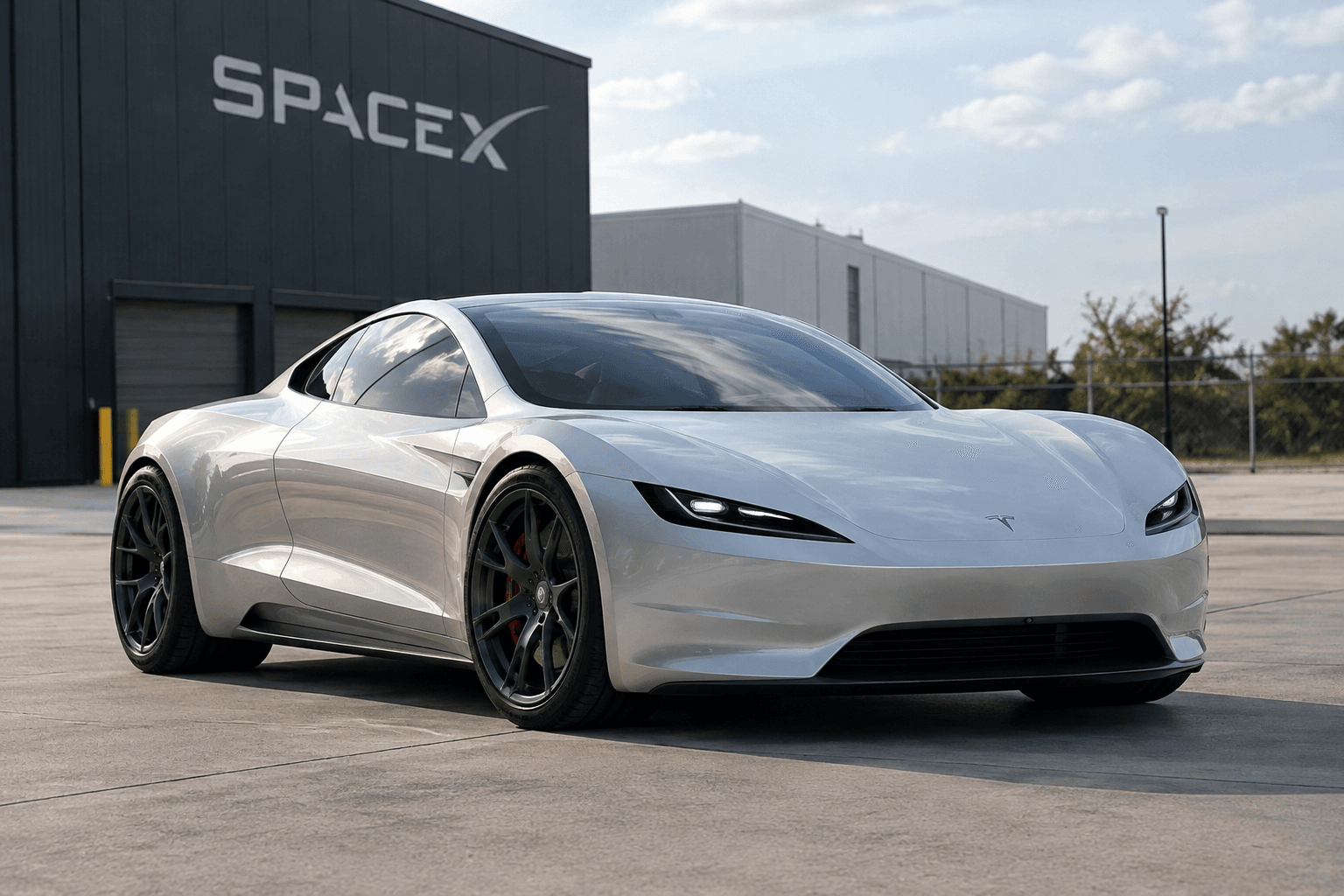
On October 15, 2026, Tesla unveiled its long-awaited second-generation Roadster, developed with SpaceX, at an event in McGregor, Texas. The prototype drove up a curved ramp, spun in the air and landed using cold-gas thrusters, later leaping over several Tesla vehicles. The company confirmed three versions -Performance, Thrust and Rocket-, with 0-60 mph times ranging from 1.6 to 0.59 seconds depending on version, and a range of more than 300 miles, roughly half of what was promised in 2017. Production won't begin until 2028, eight years after the original target.
In short
- Tesla unveiled the new Roadster, developed with SpaceX, on October 15, 2026 at an event in McGregor, Texas.
- Three versions: Performance (two seats), Thrust (two seats, rear thrusters) and Rocket (one seat, ten thrusters, brief flight capability).
- According to Tesla, 0-60 mph ranges from under 1.6 s (Performance) to under 0.59 s (Rocket); the live demo clocked 0.81 s. Range above 300 miles across all versions. Figures not independently verified.
- Production won't start until 2028, eight years after the date originally promised in 2017.
- The FAA confirmed the vehicle isn't considered an aircraft; NHTSA continues to monitor the matter without requiring specific certification.
What happened in McGregor
Tesla unveiled the new Roadster on the evening of Thursday, October 15, 2026, at a SpaceX test site near Waco, Texas, with Elon Musk, design chief Franz von Holzhausen and vehicle-engineering VP Lars Moravy on stage.
The white prototype drove up a curved ramp using a suction system, hung upside down, spun in the air and landed using built-in thrusters. Later, using the same thrusters, it leapt over a line of Tesla vehicles -a Cybercab, a Cybertruck, a Tesla Semi, a Model Y and a Model 3- twisting mid-air during the maneuver.
The demonstration had no human driver: inside sat only a mannequin in a SpaceX spacesuit, a nod to the 'Starman' dummy Tesla sent into space in 2018 aboard the original Roadster. Musk said the car operated autonomously for safety reasons.
Three versions, one that can fly
Tesla confirmed three variants, using the official labels from its own website. Performance ('road ready') is a two-seater with active aerodynamics and a multi-mode suction system; Tesla lists a 0-60 mph time under 1.6 seconds. Thrust ('race ready'), also a two-seater, adds rear-mounted cold-gas thrusters and lowers that figure to under 0.9 seconds. Rocket ('air ready') is an invitation-only single-seater, not available in all regions according to Tesla, with ten cold-gas thrusters arranged around the car, brief airborne-maneuver capability, and a 0-60 mph time under 0.59 seconds.
All of these acceleration figures come from Tesla itself and haven't been verified by an independent third party. During the live demonstration, the car hit 60 mph in 0.81 seconds on the company's own timer (0.67 seconds with rollout subtracted), according to journalists present at the event. Vehicle-engineering VP Lars Moravy said the thrusters run on about 600 liters of rechargeable compressed air. Tesla puts the Rocket version's top speed above 230 mph, another figure that hasn't been independently verified.
The aerial demonstration was a prototype showcase, not a test of a production-ready vehicle: it showed brief maneuvers, not sustained flight, and Tesla hasn't specified how long or how far the Roadster can actually stay airborne.
What's different from the 2017 promise
When Tesla first showed this Roadster generation in November 2017, it promised a four-seat car with a 1.9-second 0-60 mph time, up to 620 miles of range, and deliveries starting in 2020. The 2026 version cuts seating to a maximum of two and puts range at more than 300 miles, less than half of what was announced back then.
Tesla also hasn't announced final prices for any of the three versions; only reservation amounts are known. Under Tesla's own reservation terms and conditions, the Performance and Thrust amounts are only an 'estimate' pending confirmation closer to the start of production, and the company warns it 'cannot guarantee when your vehicle will actually be delivered or if it will be delivered.' It also hasn't said what will happen to customers who put down deposits on the 2017 version.
A regulatory gray area: neither aircraft nor ordinary car
Tesla's own website states that the Rocket version is 'not approved for public road use.' Asked by US outlets, the Federal Aviation Administration (FAA) said the vehicle doesn't meet its definition of an 'aircraft,' meaning it doesn't require airworthiness certification.
The National Highway Traffic Safety Administration (NHTSA), which oversees vehicle safety, largely relies on automakers to self-certify. The US Department of Transportation said NHTSA 'will continue to monitor the situation.'
On whether the car would be street-legal, Musk was ambiguous at the event: he said he wasn't 'sure it's necessarily legal in all jurisdictions,' and when an audience member asked directly if it would be street-legal, he replied, 'Depends on your street. But it'll be a viable car,' according to Business Insider.
Musk was explicit about the car's limits during the reveal: 'This is not necessarily a safety-optimized car, OK?' he said on stage.
Market context
Tesla reopened Roadster reservations weeks before the event, accepting deposits from buyers in the US, Canada and China; no availability has been announced in Europe or other markets. Musk himself has acknowledged at past shareholder meetings that the Roadster 'is definitely not gonna be a huge contributor to revenue' -it's a very low-volume model, conceived as a technology halo car rather than a business line. The announcement came just days before Tesla reported third-quarter results, the event markets actually watch closely.
Pricing and availability
These are reservation amounts, not final sale prices. Under Tesla's own terms and conditions, the Performance and Thrust amounts are estimates subject to change, and vehicle delivery isn't guaranteed.
Pros / Cons
- A genuine technical demonstration with thrusters developed alongside SpaceX, unprecedented in a road car.
- Up to a 0.59-second 0-60 mph time on the Rocket version, per Tesla; 0.81 s recorded during the live demo.
- The first Tesla explicitly framed as 'the last one you drive yourself,' as the company shifts focus to autonomous driving.
- Nearly a decade of delays: promised for 2020, now not entering production until 2028.
- Promised range has been cut by more than half (from 620 miles to just over 300) and seating drops from four to two.
- No final price, no firm delivery date, and regulatory ambiguity around using the thrusters.
Milestones
- Nov. 2017First revealTesla shows a prototype and promises 4 seats, 620 miles of range, 0-60 mph in 1.9s, and deliveries in 2020.
- 2020-2025Repeated delaysThe production date slips several times; Musk cites priorities like the Cybertruck and supply issues.
- Oct. 2025New demo promiseMusk says he hopes to show the car before the end of 2025; a week later, at the shareholder meeting, he pushes it to April 1, 2026.
- 2026More delays through the yearThe event slips repeatedly over the year -April, August and October 1- before the final date.
- Oct. 1, 2026Event postponed by weatherTesla attempts to hold the reveal, but severe weather forces another delay.
- Oct. 15, 2026Reveal in McGregorTesla shows the final Roadster with SpaceX thrusters and confirms production for 2028.
Key fact
The FAA has told US outlets that the Roadster doesn't meet its definition of an 'aircraft,' so it doesn't require airworthiness certification; NHTSA, meanwhile, isn't requiring specific approval for the thrusters and says it will simply 'continue to monitor the situation,' per the US Department of Transportation.
Demonstration vs. final product
What was shown in McGregor was a prototype in a controlled demonstration, not a production vehicle or a sustained-flight test. The acceleration, top-speed and range figures come from Tesla itself and haven't been verified by an independent body. Tesla has already missed every production date it has announced for this model since 2017. Tesla's own reservation terms also warn that delivery 'is not guaranteed.'
This is not necessarily a safety-optimized car, OK?
Elon Musk, at the Roadster reveal in McGregor, Texas